Enlarge/ MUMBAI, INDIA JUNE 7: A health worker collects swab samples of a citizen for Covid-19 test after cases are on the rise in the city, at TMC's C.R. Wadia Hospital testing centre, in Thane, on June 7, 2022 in Mumbai, India. (credit: Getty | Hindustan Times)
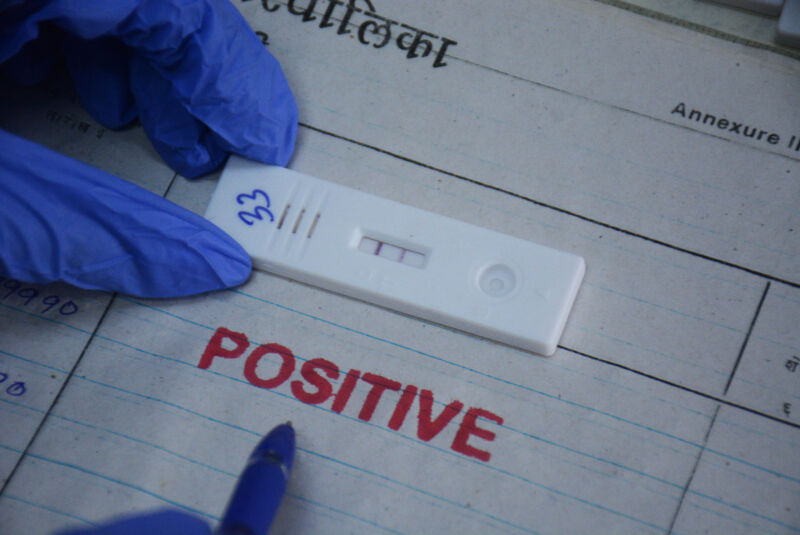
As the omicron coronavirus subvariant BA.5 blazes through the US—accounting for an estimated 54 percent of cases in the country—experts are eyeing another subvariant that threatens to follow hot on its heels.
The subvariant is referred to as BA.2.75 and was first detected in India in late May. Amid a backdrop of BA.2 and BA.5 circulating in India, the newcomer BA.2.75 began quickly gaining ground in June. This week it reached 23 percent of recent virus samples there. Meanwhile, spread beyond India's borders. It is now present in about 10 other countries, including the US, according to the World Health Organization.
Experts are concerned about the new subvariant, not just because of its rapid rise. It has several mutations in its spike protein—the critical protein that allows the virus to latch onto human cells and the protein that acts as a prime target for immune responses. In particular, BA.2.75 has key mutations that suggest it could be good at evading antibody responses in people who have been vaccinated and/or previously infected with earlier omicron subvariants.
Keep it Clean. Please avoid obscene, vulgar, lewd,
racist or sexually-oriented language. PLEASE TURN OFF YOUR CAPS LOCK. Don't Threaten. Threats of harming another
person will not be tolerated. Be Truthful. Don't knowingly lie about anyone
or anything. Be Nice. No racism, sexism or any sort of -ism
that is degrading to another person. Be Proactive. Use the 'Report' link on
each comment to let us know of abusive posts. Share with Us. We'd love to hear eyewitness
accounts, the history behind an article.


(0) comments
Welcome to the discussion.
Log In
Keep it Clean. Please avoid obscene, vulgar, lewd, racist or sexually-oriented language.
PLEASE TURN OFF YOUR CAPS LOCK.
Don't Threaten. Threats of harming another person will not be tolerated.
Be Truthful. Don't knowingly lie about anyone or anything.
Be Nice. No racism, sexism or any sort of -ism that is degrading to another person.
Be Proactive. Use the 'Report' link on each comment to let us know of abusive posts.
Share with Us. We'd love to hear eyewitness accounts, the history behind an article.