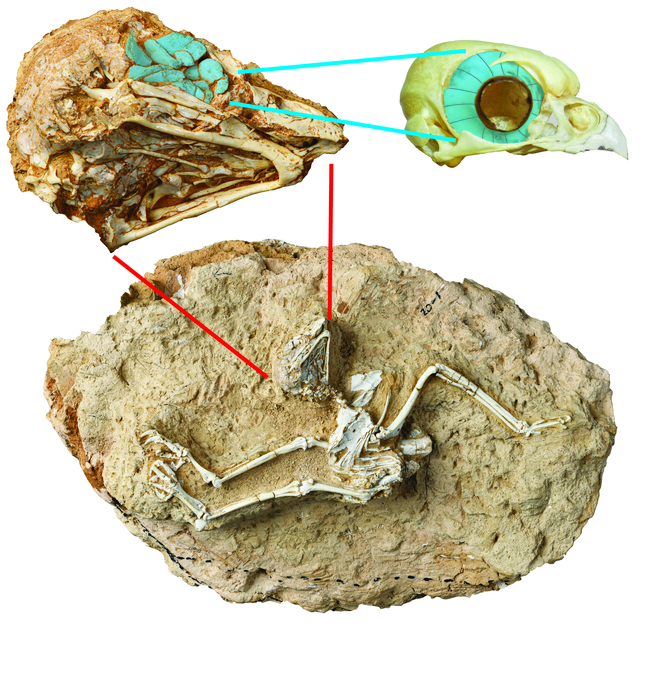
An extraordinarily well-preserved fossil owl was described inPNASthis past March. Owls are not new to the fossil record; evidence of their existence has been found in scattered limbs and fragments from the Pleistocene to the Paleocene (approximately 11,700 years to 65 million years ago). What makes this fossil unique is not only the rare preservation of its near-complete articulated skeleton but that it provides the first evidence of diurnal behavior millions of years earlier than previously thought.
In other words, this ancient owl didn’t stalk its prey under the cloak of darkness. Instead, the bird was active under the rays of the Miocene sun.
Seeing the light
Its eye socket was key to making this determination. Dr. Zhiheng Li is the lead author on the paper and a vertebrate paleontologist who focuses on fossil birds at theInstitute of Vertebrate Paleontology and Paleoanthropology(IVPP) in China. He explained in an email that the large bones around the eyes of birds (but not mammals) known as the scleral ossicles offer information about the size of the pupil they surround. In this case, the pupils of this fossil owl were small. And if the pupil is small, he wrote, it “means they can obtain good vision with a smaller eye opening.”
Keep it Clean. Please avoid obscene, vulgar, lewd,
racist or sexually-oriented language. PLEASE TURN OFF YOUR CAPS LOCK. Don't Threaten. Threats of harming another
person will not be tolerated. Be Truthful. Don't knowingly lie about anyone
or anything. Be Nice. No racism, sexism or any sort of -ism
that is degrading to another person. Be Proactive. Use the 'Report' link on
each comment to let us know of abusive posts. Share with Us. We'd love to hear eyewitness
accounts, the history behind an article.


(0) comments
Welcome to the discussion.
Log In
Keep it Clean. Please avoid obscene, vulgar, lewd, racist or sexually-oriented language.
PLEASE TURN OFF YOUR CAPS LOCK.
Don't Threaten. Threats of harming another person will not be tolerated.
Be Truthful. Don't knowingly lie about anyone or anything.
Be Nice. No racism, sexism or any sort of -ism that is degrading to another person.
Be Proactive. Use the 'Report' link on each comment to let us know of abusive posts.
Share with Us. We'd love to hear eyewitness accounts, the history behind an article.