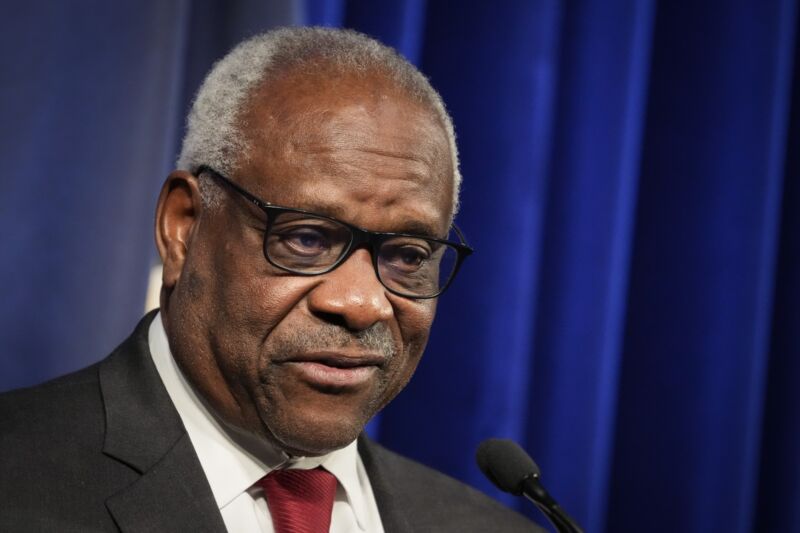
Enlarge/ Supreme Court Justice Clarence Thomas speaks at the Heritage Foundation on October 21, 2021, in Washington, DC. (credit: Getty Images | Drew Angerer )
With tech groups asking the US Supreme Court to block the new Texas law against social media "censorship," the state's defense relies in part on an opinion issued last year by Justice Clarence Thomas in a case involving Donald Trump and Twitter.
Thomas' opinion, as we wrote at the time, criticized the Section 230 legal protections given to online platforms' moderation decisions and argued that free-speech law shouldn't necessarily prevent lawmakers from regulating those platforms as common carriers.
"In many ways, digital platforms that hold themselves out to the public resemble traditional common carriers," Thomas wrote. "Though digital instead of physical, they are at bottom communications networks, and they 'carry' information from one user to another. A traditional telephone company laid physical wires to create a network connecting people. Digital platforms lay information infrastructure that can be controlled in much the same way." The similarity between online platforms and common carriers "is even clearer for digital platforms that have dominant market share," Thomas also wrote.
Keep it Clean. Please avoid obscene, vulgar, lewd,
racist or sexually-oriented language. PLEASE TURN OFF YOUR CAPS LOCK. Don't Threaten. Threats of harming another
person will not be tolerated. Be Truthful. Don't knowingly lie about anyone
or anything. Be Nice. No racism, sexism or any sort of -ism
that is degrading to another person. Be Proactive. Use the 'Report' link on
each comment to let us know of abusive posts. Share with Us. We'd love to hear eyewitness
accounts, the history behind an article.


(0) comments
Welcome to the discussion.
Log In
Keep it Clean. Please avoid obscene, vulgar, lewd, racist or sexually-oriented language.
PLEASE TURN OFF YOUR CAPS LOCK.
Don't Threaten. Threats of harming another person will not be tolerated.
Be Truthful. Don't knowingly lie about anyone or anything.
Be Nice. No racism, sexism or any sort of -ism that is degrading to another person.
Be Proactive. Use the 'Report' link on each comment to let us know of abusive posts.
Share with Us. We'd love to hear eyewitness accounts, the history behind an article.