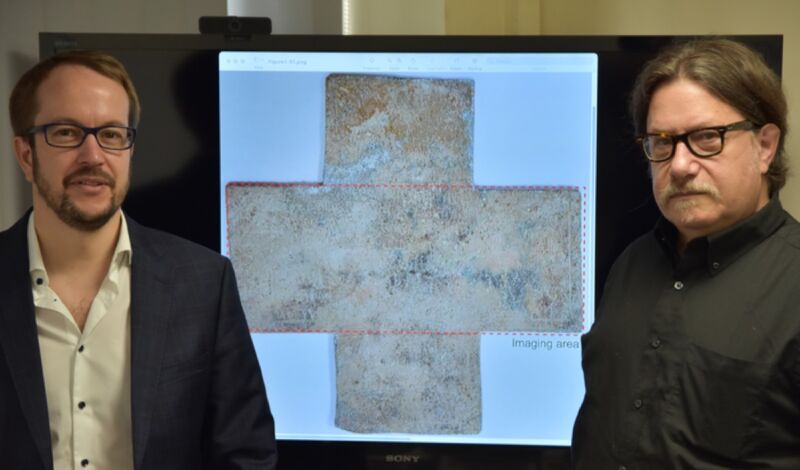
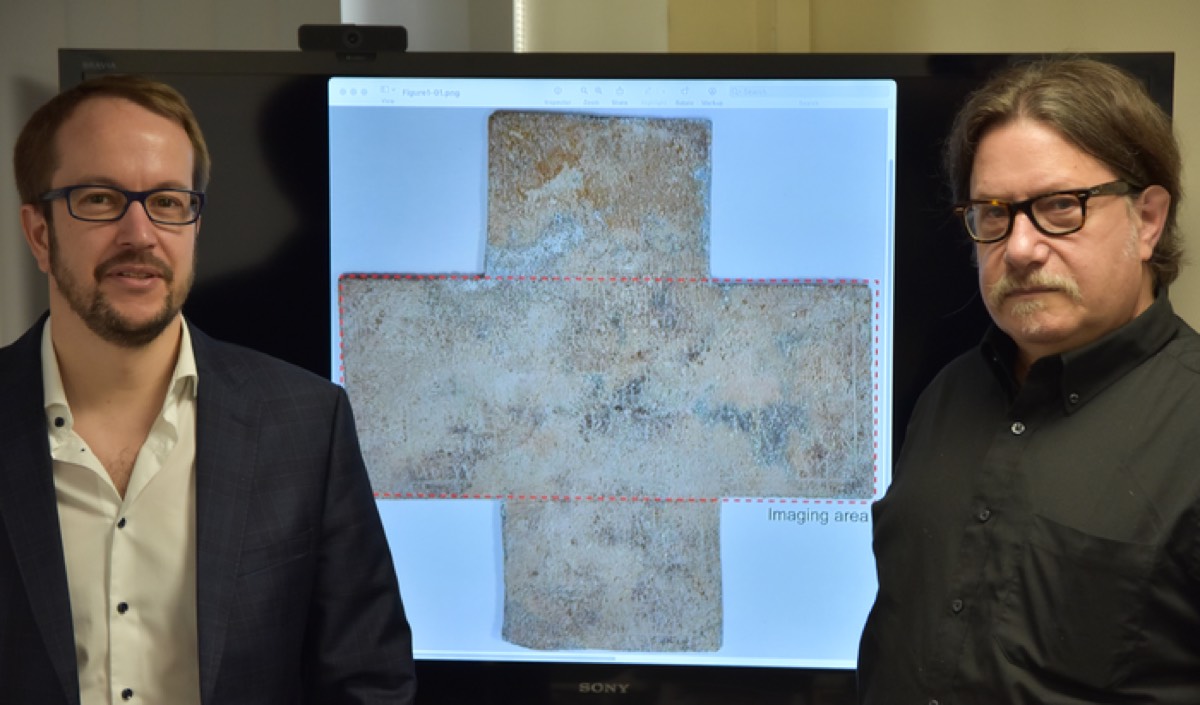
Enlarge/ Georgia Tech's Alexandre Locquet (left) and David Citrin (right) with an image of the 16th-century funerary cross used in their study. (credit: Georgia Tech-Lorraine)
In 1843, archaeologists excavated the burial grounds of Remiremont Abbey in Lorraine, France (the abbey was founded in the 7th century). It was medieval custom to bury the deceased with cross-shaped plaques cut from thin sheets of lead placed across the chest. The crosses often included inscribed prayers, but many of those inscriptions have been rendered unreadable over the ensuing centuries by layers of corrosion. Now, an interdisciplinary team of scientists has successfully subjected one such funerary cross to terahertz (THz) imaging and revealed its hidden inscription—fragments of the Lord's Prayer (Pater Noster)—according to a new paper published in the journal Scientific Reports.
“Our approach enabled us to read a text that was hidden beneath corrosion, perhaps for hundreds of years,” said co-author Alexandre Locquet of Georgia Tech-Lorraine in Metz, France. “Clearly, approaches that access such information without damaging the object are of great interest to archaeologists.” According to the authors, this approach is also useful for studying historical paintings, detecting skin cancer, measuring the thickness of automotive paints, and making sure turbine blade coatings adhere properly.
In recent years, a variety of cutting-edge non-destructive imaging methods have proved to be a boon to art conservationists and archaeologists alike. Each technique has its advantages and disadvantages. For instance, ground-penetrating radar (radio waves) is great for locating buried artifacts, among other uses, while lidar is useful for creating high-resolution maps of surface terrain. Infrared reflectography is well-suited to certain artworks whose materials contain pigments that reflect a lot of infrared light. Ultraviolet light is ideal for identifying varnishes and detecting any retouching that was done with white pigments containing zinc and titanium, although UV light doesn't penetrate paint layers.
Keep it Clean. Please avoid obscene, vulgar, lewd,
racist or sexually-oriented language. PLEASE TURN OFF YOUR CAPS LOCK. Don't Threaten. Threats of harming another
person will not be tolerated. Be Truthful. Don't knowingly lie about anyone
or anything. Be Nice. No racism, sexism or any sort of -ism
that is degrading to another person. Be Proactive. Use the 'Report' link on
each comment to let us know of abusive posts. Share with Us. We'd love to hear eyewitness
accounts, the history behind an article.


(0) comments
Welcome to the discussion.
Log In
Keep it Clean. Please avoid obscene, vulgar, lewd, racist or sexually-oriented language.
PLEASE TURN OFF YOUR CAPS LOCK.
Don't Threaten. Threats of harming another person will not be tolerated.
Be Truthful. Don't knowingly lie about anyone or anything.
Be Nice. No racism, sexism or any sort of -ism that is degrading to another person.
Be Proactive. Use the 'Report' link on each comment to let us know of abusive posts.
Share with Us. We'd love to hear eyewitness accounts, the history behind an article.