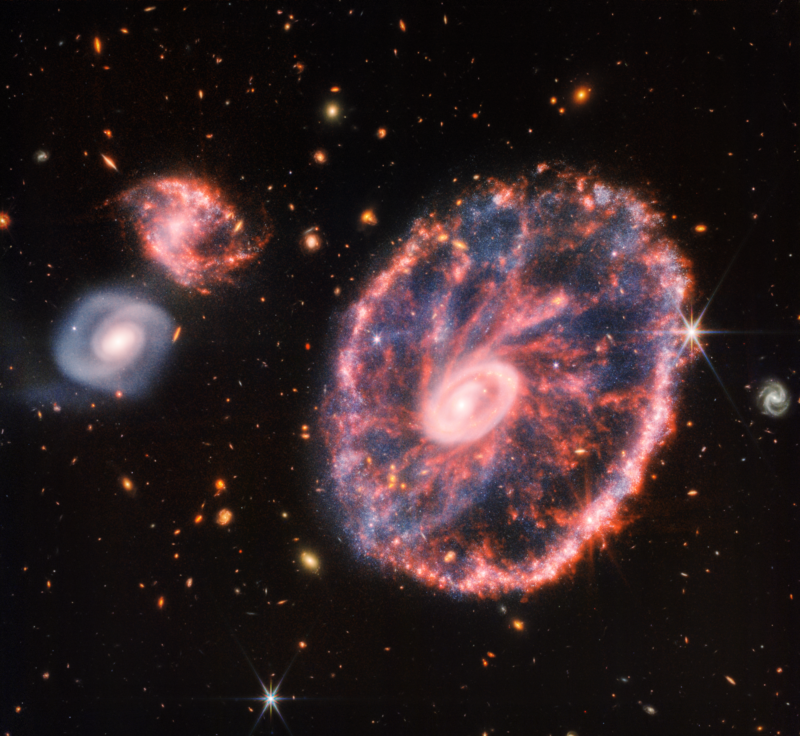
Enlarge/ The dust in this galaxy, shaded red, required the MIRI instrument to resolve. (credit: NASA, ESA, CSA, STScI)
There is more than one reason why the Mid-Infrared Instrument (MIRI) on board the James Webb Space Telescope (JWST) is considered to be pioneering. Of the four instruments on JWST, it's the only one that observes in the mid-infrared range, from 5 to 28 microns; the other three are near-infrared devices with a wavelength range of 0.6 to 5 microns. To reach these wavelengths, MIRI had to be kept the coldest of any instrument on JWST, meaning it essentially set the requirements for the telescope’s cooling system.
The stunning images taken by MIRI are a testimony to the remarkable engineering feats that went into it, feats that were achieved by overcoming formidable challenges through meticulous transatlantic teamwork and coordination.
Making MIRI
“I remember being told in the early days that the instrument will never be built. Some people at NASA looked at the block diagram of our management structure and said it will never work,” Professor George Rieke, who leads the science team of MIRI, recalled.
Keep it Clean. Please avoid obscene, vulgar, lewd,
racist or sexually-oriented language. PLEASE TURN OFF YOUR CAPS LOCK. Don't Threaten. Threats of harming another
person will not be tolerated. Be Truthful. Don't knowingly lie about anyone
or anything. Be Nice. No racism, sexism or any sort of -ism
that is degrading to another person. Be Proactive. Use the 'Report' link on
each comment to let us know of abusive posts. Share with Us. We'd love to hear eyewitness
accounts, the history behind an article.


(0) comments
Welcome to the discussion.
Log In
Keep it Clean. Please avoid obscene, vulgar, lewd, racist or sexually-oriented language.
PLEASE TURN OFF YOUR CAPS LOCK.
Don't Threaten. Threats of harming another person will not be tolerated.
Be Truthful. Don't knowingly lie about anyone or anything.
Be Nice. No racism, sexism or any sort of -ism that is degrading to another person.
Be Proactive. Use the 'Report' link on each comment to let us know of abusive posts.
Share with Us. We'd love to hear eyewitness accounts, the history behind an article.