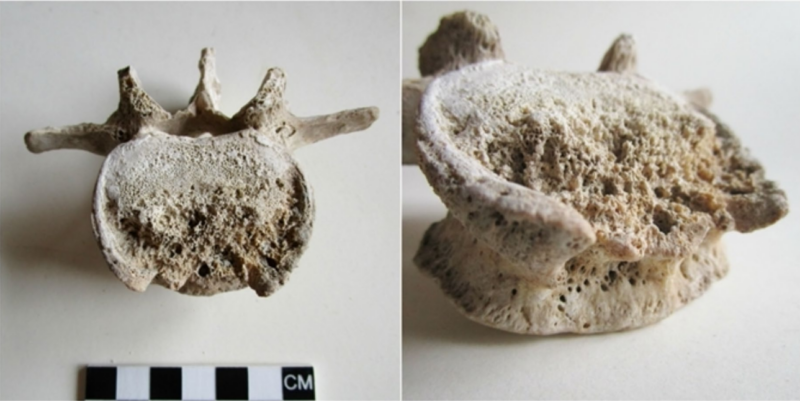
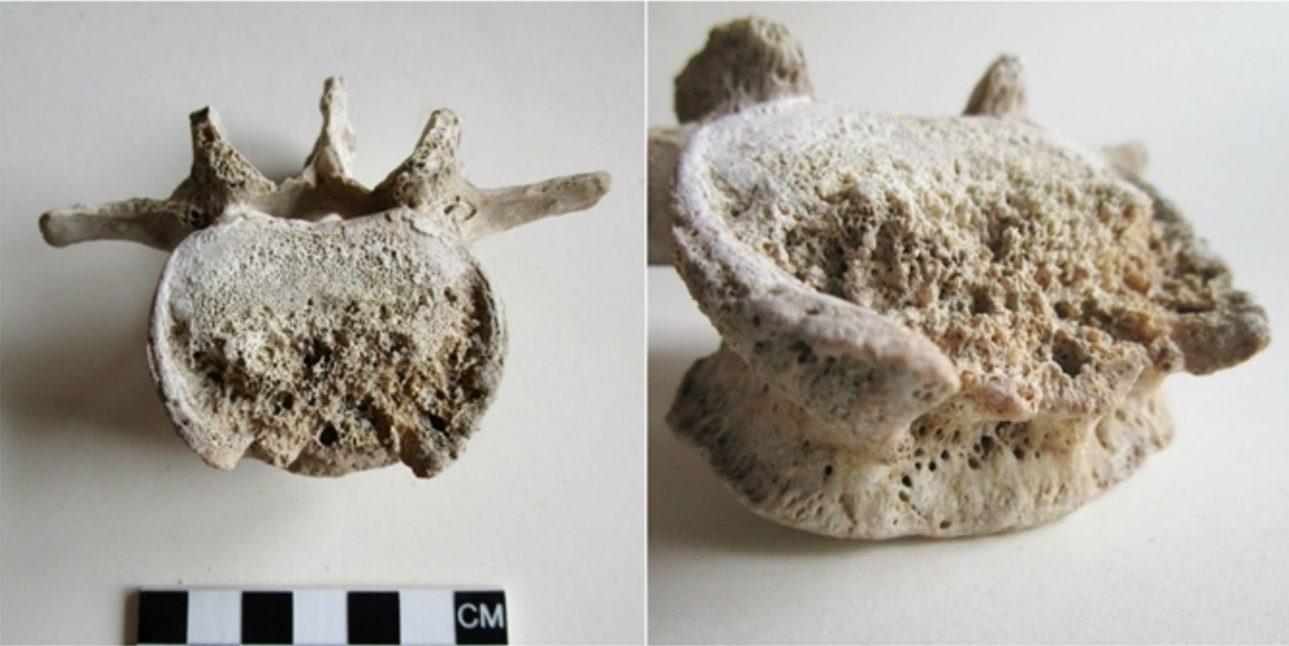
Enlarge/ This is not what a healthy lumbar vertebra is supposed to look like. (credit: Scorrano et al. 2022)
The eruption of Mount Vesuvius buried the Roman city of Pompeii in ash in 79 CE. Anthropologists recently sequenced ancient DNA from one of the victims, a man in his late 30s, providing a glimpse into the family background of a Roman citizen.
The results also suggest that he suffered from a tuberculosis infection in his lower spine. In one of the victim’s vertebrae, the study found DNA from the bacterium that causes tuberculosis, suggesting that the infection had traveled through the bloodstream from his lungs to his lower spine.
Pompeii man was Italian
A team led by anthropologist Gabriele Scorrano of the University of Rome sequenced the genome of the victim, which revealed, unsurprisingly, that man was of central Italian descent. Although the ancient man’s genome didn’t yield much new information about life in Pompeii, it proves that bones from Pompeii may still contain enough DNA to sequence—and that could be exciting news.
Keep it Clean. Please avoid obscene, vulgar, lewd,
racist or sexually-oriented language. PLEASE TURN OFF YOUR CAPS LOCK. Don't Threaten. Threats of harming another
person will not be tolerated. Be Truthful. Don't knowingly lie about anyone
or anything. Be Nice. No racism, sexism or any sort of -ism
that is degrading to another person. Be Proactive. Use the 'Report' link on
each comment to let us know of abusive posts. Share with Us. We'd love to hear eyewitness
accounts, the history behind an article.


(0) comments
Welcome to the discussion.
Log In
Keep it Clean. Please avoid obscene, vulgar, lewd, racist or sexually-oriented language.
PLEASE TURN OFF YOUR CAPS LOCK.
Don't Threaten. Threats of harming another person will not be tolerated.
Be Truthful. Don't knowingly lie about anyone or anything.
Be Nice. No racism, sexism or any sort of -ism that is degrading to another person.
Be Proactive. Use the 'Report' link on each comment to let us know of abusive posts.
Share with Us. We'd love to hear eyewitness accounts, the history behind an article.