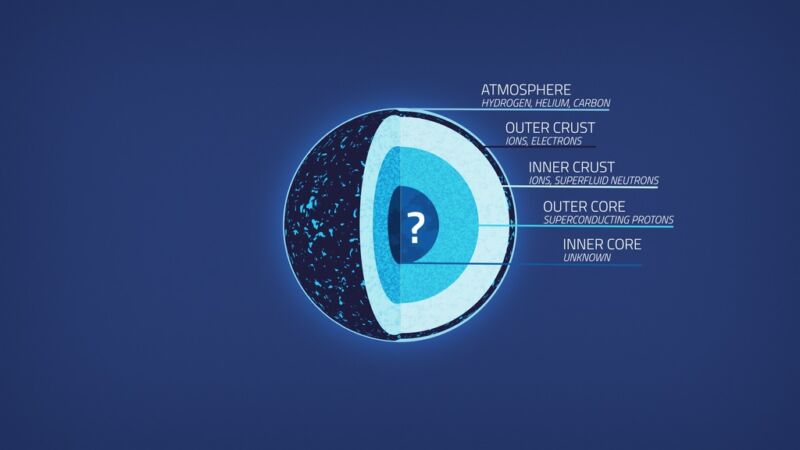
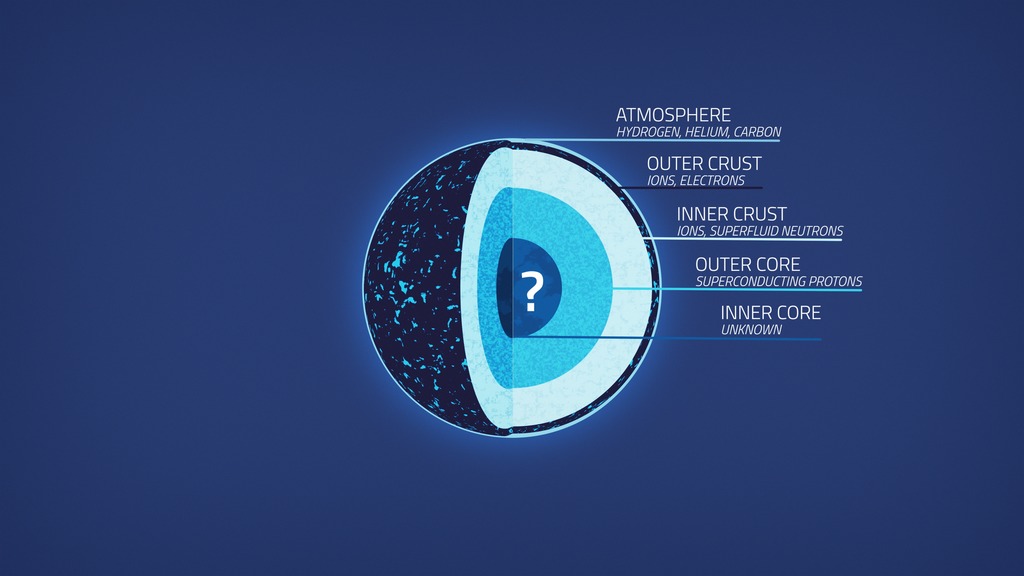
Enlarge/ The new research hasn't made a breakthrough, but it has shrunk the size of the question mark a bit. (credit: NASA)
How can we understand environments that can't be replicated on Earth? That's a challenge astrophysicists face all the time. In some cases, it's largely a matter of figuring out how well-understood physics applies to extreme conditions and then comparing the output of those equations to observations. But a notable exception to that is a neutron star, where the relevant equations get completely intractable, and observations don't provide many details.
So, while we're pretty sure there's a layer of nearly pure neutrons near the surface of these bodies, we're very uncertain as to what might exist deeper in their interiors.
This week, Nature is publishing a study that tries to move us closer to an understanding. It doesn't give us an answer—there's still a lot of uncertainty. But it's a great opportunity to look at the process of how scientists can take data from a huge range of sources and start whittling away at those uncertainties.
Keep it Clean. Please avoid obscene, vulgar, lewd,
racist or sexually-oriented language. PLEASE TURN OFF YOUR CAPS LOCK. Don't Threaten. Threats of harming another
person will not be tolerated. Be Truthful. Don't knowingly lie about anyone
or anything. Be Nice. No racism, sexism or any sort of -ism
that is degrading to another person. Be Proactive. Use the 'Report' link on
each comment to let us know of abusive posts. Share with Us. We'd love to hear eyewitness
accounts, the history behind an article.


(0) comments
Welcome to the discussion.
Log In
Keep it Clean. Please avoid obscene, vulgar, lewd, racist or sexually-oriented language.
PLEASE TURN OFF YOUR CAPS LOCK.
Don't Threaten. Threats of harming another person will not be tolerated.
Be Truthful. Don't knowingly lie about anyone or anything.
Be Nice. No racism, sexism or any sort of -ism that is degrading to another person.
Be Proactive. Use the 'Report' link on each comment to let us know of abusive posts.
Share with Us. We'd love to hear eyewitness accounts, the history behind an article.