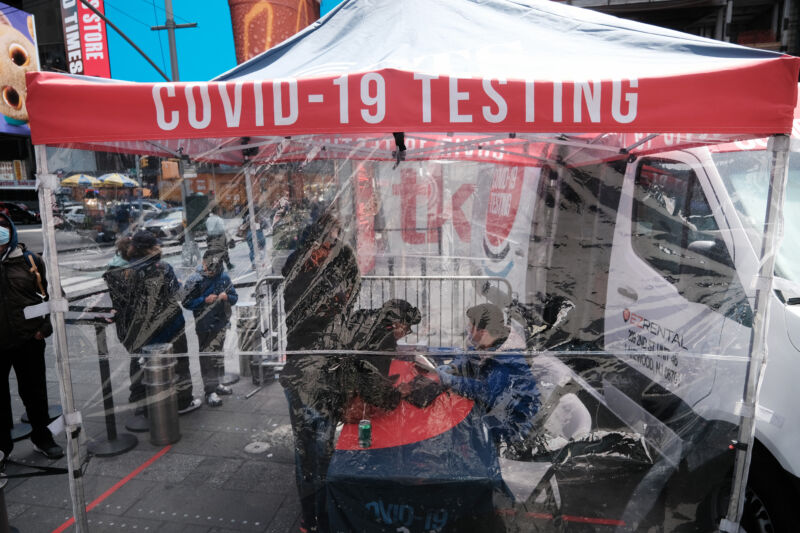
Enlarge/ A COVID-19 testing tent stands in Times Square on April 27, 2022, in New York City. (credit: Getty | Spencer Platt)
Enduring an initial omicron infection may not spare you from omicron's subvariants, according to preliminary data from South Africa.
The country is currently at the start of a new wave of infections, primarily driven by two omicron coronavirus subvariants, BA.4 and BA.5. Despite a towering wave of cases from the initial BA.1 omicron variant in December that infected a large chunk of the country, new omicron cases increased 259 percent in the last two weeks, according to data tracking by The New York Times. Hospitalizations are also up, and deaths have increased by 18 percent.
Preliminary data posted online last week helps explain why cases are once again surging—the BA.4 and BA.5 omicron subvariants can evade neutralizing antibodies generated by infections from BA.1. For the study, led by virologist Alex Sigal of the Africa Health Research Institute, researchers pitted neutralization antibodies from people infected with BA.1 up against BA.4 and BA.5 in a lab. They had samples from 24 unvaccinated people infected with BA.1 and 15 vaccinated people who had also had a BA.1 infection (eight people were vaccinated with the Pfizer/BioNTech vaccine, and seven had the Johnson & Johnson vaccine).
Keep it Clean. Please avoid obscene, vulgar, lewd,
racist or sexually-oriented language. PLEASE TURN OFF YOUR CAPS LOCK. Don't Threaten. Threats of harming another
person will not be tolerated. Be Truthful. Don't knowingly lie about anyone
or anything. Be Nice. No racism, sexism or any sort of -ism
that is degrading to another person. Be Proactive. Use the 'Report' link on
each comment to let us know of abusive posts. Share with Us. We'd love to hear eyewitness
accounts, the history behind an article.


(0) comments
Welcome to the discussion.
Log In
Keep it Clean. Please avoid obscene, vulgar, lewd, racist or sexually-oriented language.
PLEASE TURN OFF YOUR CAPS LOCK.
Don't Threaten. Threats of harming another person will not be tolerated.
Be Truthful. Don't knowingly lie about anyone or anything.
Be Nice. No racism, sexism or any sort of -ism that is degrading to another person.
Be Proactive. Use the 'Report' link on each comment to let us know of abusive posts.
Share with Us. We'd love to hear eyewitness accounts, the history behind an article.