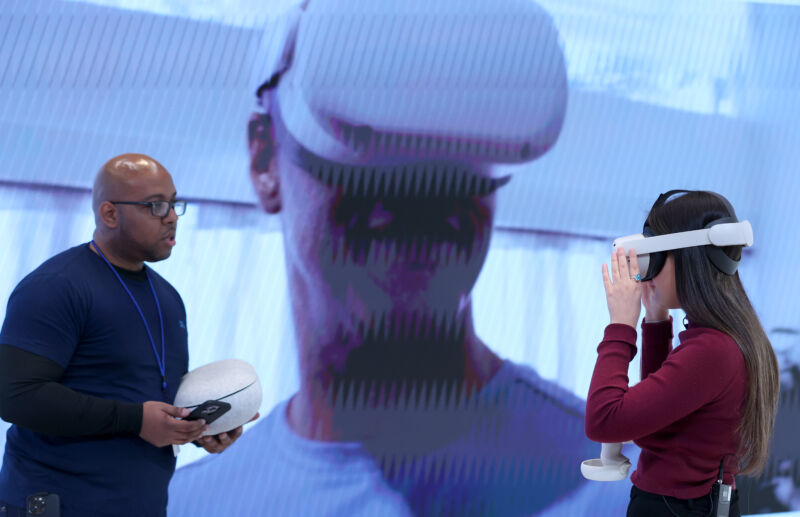
Enlarge/ BURLINGAME, CALIFORNIA - MAY 04: Meta employee Ryan Carter (L) helps a member of the media with an Oculus virtual reality headset demonstration during a media preview of the new Meta Store on May 04, 2022 in Burlingame, California. Meta is set to open its first physical retail store on May 9. (Photo by Justin Sullivan/Getty Images) (credit: Justin Sullivan | Getty Images)
Meta is facing a growing backlash for the charges imposed on apps created for its virtual reality headsets, as developers complain about the commercial terms set around futuristic devices that the company hopes will help create a multibillion-dollar consumer market.
Facebook’s parent has pledged to spend $10 billion a year over the next decade on the “metaverse,” a much-hyped concept denoting an immersive virtual world filled with avatars.
The investment is spurred by a desire to own the next computing platform and avoid being trapped by rules set by Big Tech rivals, as it has been by Apple and Google with their respective mobile app stores.
Keep it Clean. Please avoid obscene, vulgar, lewd,
racist or sexually-oriented language. PLEASE TURN OFF YOUR CAPS LOCK. Don't Threaten. Threats of harming another
person will not be tolerated. Be Truthful. Don't knowingly lie about anyone
or anything. Be Nice. No racism, sexism or any sort of -ism
that is degrading to another person. Be Proactive. Use the 'Report' link on
each comment to let us know of abusive posts. Share with Us. We'd love to hear eyewitness
accounts, the history behind an article.


(0) comments
Welcome to the discussion.
Log In
Keep it Clean. Please avoid obscene, vulgar, lewd, racist or sexually-oriented language.
PLEASE TURN OFF YOUR CAPS LOCK.
Don't Threaten. Threats of harming another person will not be tolerated.
Be Truthful. Don't knowingly lie about anyone or anything.
Be Nice. No racism, sexism or any sort of -ism that is degrading to another person.
Be Proactive. Use the 'Report' link on each comment to let us know of abusive posts.
Share with Us. We'd love to hear eyewitness accounts, the history behind an article.