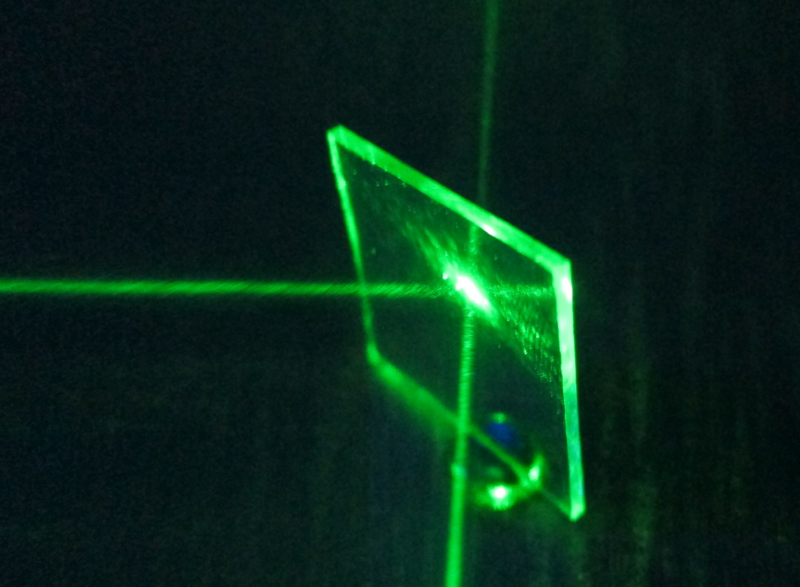
Enlarge/ Given an actual beam of light, a beamsplitter divides it in two. Given individual photons, the behavior becomes more complicated. (credit: Wikipedia)
Ars Technica's Chris Lee has spent a good portion of his adult life playing with lasers, so he's a big fan of photon-based quantum computing. Even as various forms of physical hardware like superconducting wires and trapped ions made progress, it was possible to find him gushing about an optical quantum computer put together by a Canadian startup called Xanadu. But, in the year since Xanadu described its hardware, companies using that other technology continued to make progress by cutting down error rates, exploring new technologies, and upping the qubit count.
But the advantage of optical quantum computing didn't go away, and now Xanadu is back with a reminder that it hasn't gone away either. Thanks to some tweaks to the design it described a year ago, Xanadu is now able to sometimes perform operations with more than 200 qubits. And it's shown that simulating the behavior of just one of those operations on a supercomputer would take 9,000 years, while its optical quantum computer can do them in just a few dozen milliseconds.
This is an entirely contrived benchmark: just as Google's quantum computer did, the quantum computer is just being itself while the supercomputer is trying to simulate it. The news here is more about the potential of Xanadu's hardware to scale.
Keep it Clean. Please avoid obscene, vulgar, lewd,
racist or sexually-oriented language. PLEASE TURN OFF YOUR CAPS LOCK. Don't Threaten. Threats of harming another
person will not be tolerated. Be Truthful. Don't knowingly lie about anyone
or anything. Be Nice. No racism, sexism or any sort of -ism
that is degrading to another person. Be Proactive. Use the 'Report' link on
each comment to let us know of abusive posts. Share with Us. We'd love to hear eyewitness
accounts, the history behind an article.



(0) comments
Welcome to the discussion.
Log In
Keep it Clean. Please avoid obscene, vulgar, lewd, racist or sexually-oriented language.
PLEASE TURN OFF YOUR CAPS LOCK.
Don't Threaten. Threats of harming another person will not be tolerated.
Be Truthful. Don't knowingly lie about anyone or anything.
Be Nice. No racism, sexism or any sort of -ism that is degrading to another person.
Be Proactive. Use the 'Report' link on each comment to let us know of abusive posts.
Share with Us. We'd love to hear eyewitness accounts, the history behind an article.