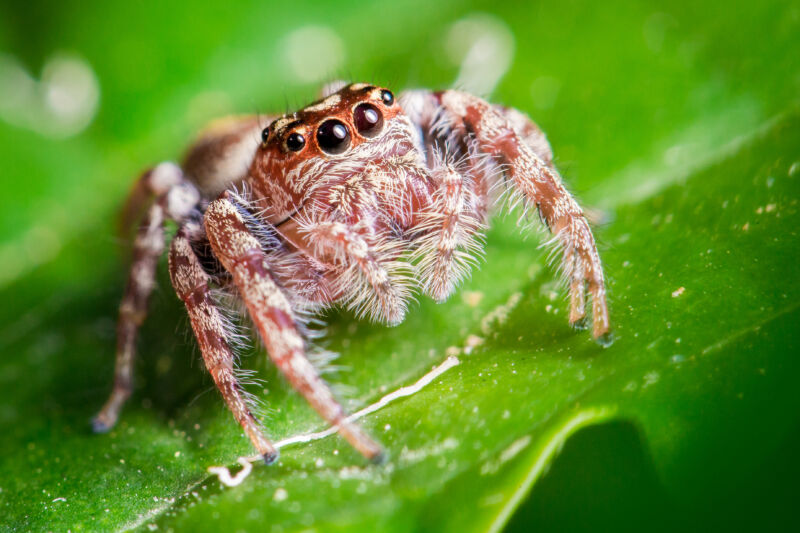
Enlarge/ This little guy looks too perky to need a nap. (credit: Tony Liu)
Our sleep is marked by cycles of distinct brain activity. The most well-known of these is probably rapid eye movement, or REM sleep, which is characterized by loss of muscle control leading to twitching and paralysis, along with its eponymous eye movements. REM sleep is widespread in vertebrates, appearing in many mammals and birds; similar periods have also been observed in lizards.
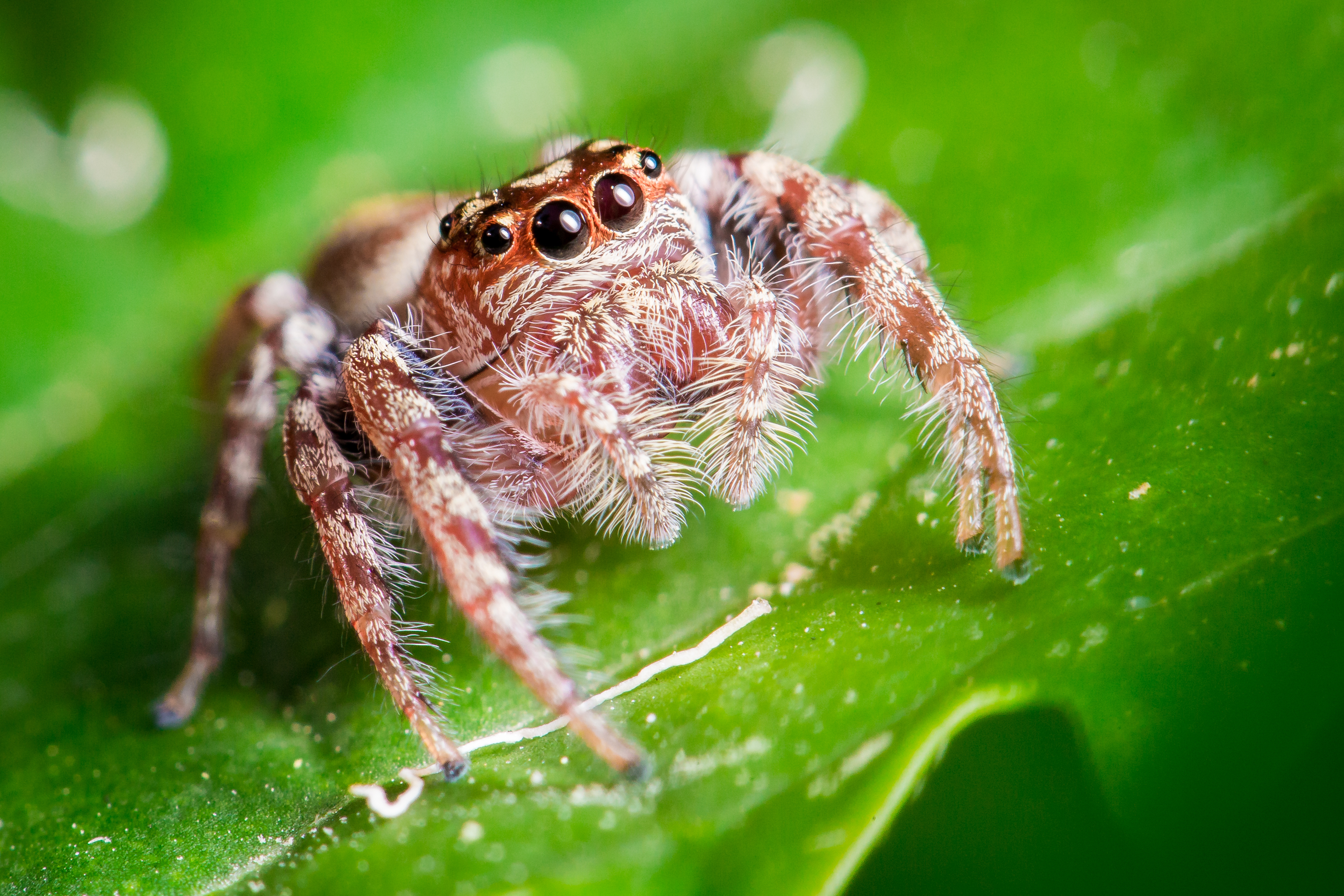
Figuring out what might be going on beyond vertebrates can get a bit challenging, however, as identifying what constitutes sleep isn't always clear, and many animals don't have eyes that move in the same way as those of vertebrates. (Flies, for example, must move their entire head to reorient their eyes.) But an international team of researchers identified a group of jumping spiders that can reorient internal portions of their eyes during what appears to be sleep.
And according to this team, the spiders experience all the hallmarks of REM sleep, with periods of rapid eye movements associated with muscle twitching.
Keep it Clean. Please avoid obscene, vulgar, lewd,
racist or sexually-oriented language. PLEASE TURN OFF YOUR CAPS LOCK. Don't Threaten. Threats of harming another
person will not be tolerated. Be Truthful. Don't knowingly lie about anyone
or anything. Be Nice. No racism, sexism or any sort of -ism
that is degrading to another person. Be Proactive. Use the 'Report' link on
each comment to let us know of abusive posts. Share with Us. We'd love to hear eyewitness
accounts, the history behind an article.


(0) comments
Welcome to the discussion.
Log In
Keep it Clean. Please avoid obscene, vulgar, lewd, racist or sexually-oriented language.
PLEASE TURN OFF YOUR CAPS LOCK.
Don't Threaten. Threats of harming another person will not be tolerated.
Be Truthful. Don't knowingly lie about anyone or anything.
Be Nice. No racism, sexism or any sort of -ism that is degrading to another person.
Be Proactive. Use the 'Report' link on each comment to let us know of abusive posts.
Share with Us. We'd love to hear eyewitness accounts, the history behind an article.