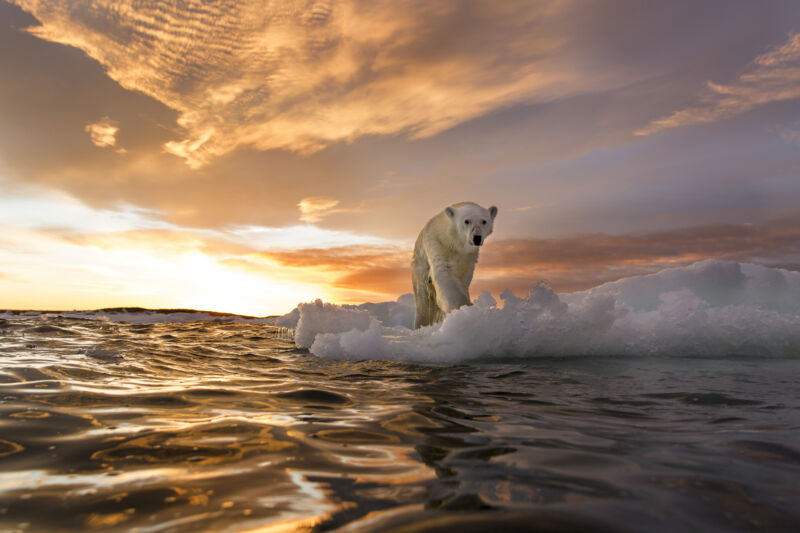
In the southeast corner of Greenland, scientists have discovered an unexpected population of polar bears. This population has developed distinct habits to survive in its odd—as far as polar bears are concerned—habitat, and the bears' genomes are quite different from many of their kin. Beyond the novelty these animals represent, they could also help inform scientists about how more traditional bears will fare in a warming Arctic, according to new research.
Several things set this group of bears apart. For much of the year, they survive by hunting from ice that falls into the ocean after breaking off a Greenland glacier; the ice floats in the fjords these bears call home. This is unlike most other populations of polar bears, which require sea ice for hunting. According to the World Wildlife Fund, between 22,000 and 31,000 polar bears are left in the world.
The research team used seven years of data collected in the region, along with 30 years of historic data. For the new data, the team connected with local hunters and used tissue samples taken from the hunters’ kills to sequence the bears' genomes. They also used fieldwork, satellite data—which also allowed them to study the geographical and sea ice conditions of the region—and tracking collars to get a sense of the bears’ movements.
Keep it Clean. Please avoid obscene, vulgar, lewd,
racist or sexually-oriented language. PLEASE TURN OFF YOUR CAPS LOCK. Don't Threaten. Threats of harming another
person will not be tolerated. Be Truthful. Don't knowingly lie about anyone
or anything. Be Nice. No racism, sexism or any sort of -ism
that is degrading to another person. Be Proactive. Use the 'Report' link on
each comment to let us know of abusive posts. Share with Us. We'd love to hear eyewitness
accounts, the history behind an article.


(0) comments
Welcome to the discussion.
Log In
Keep it Clean. Please avoid obscene, vulgar, lewd, racist or sexually-oriented language.
PLEASE TURN OFF YOUR CAPS LOCK.
Don't Threaten. Threats of harming another person will not be tolerated.
Be Truthful. Don't knowingly lie about anyone or anything.
Be Nice. No racism, sexism or any sort of -ism that is degrading to another person.
Be Proactive. Use the 'Report' link on each comment to let us know of abusive posts.
Share with Us. We'd love to hear eyewitness accounts, the history behind an article.