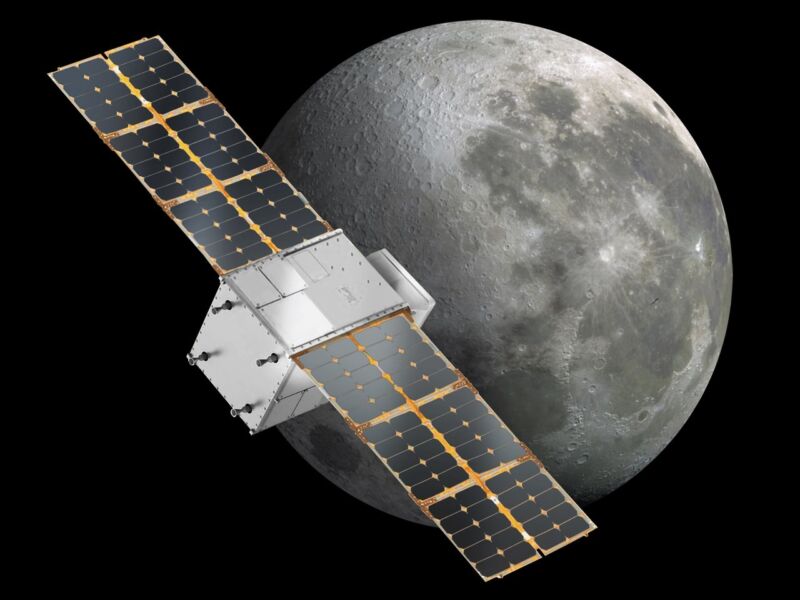
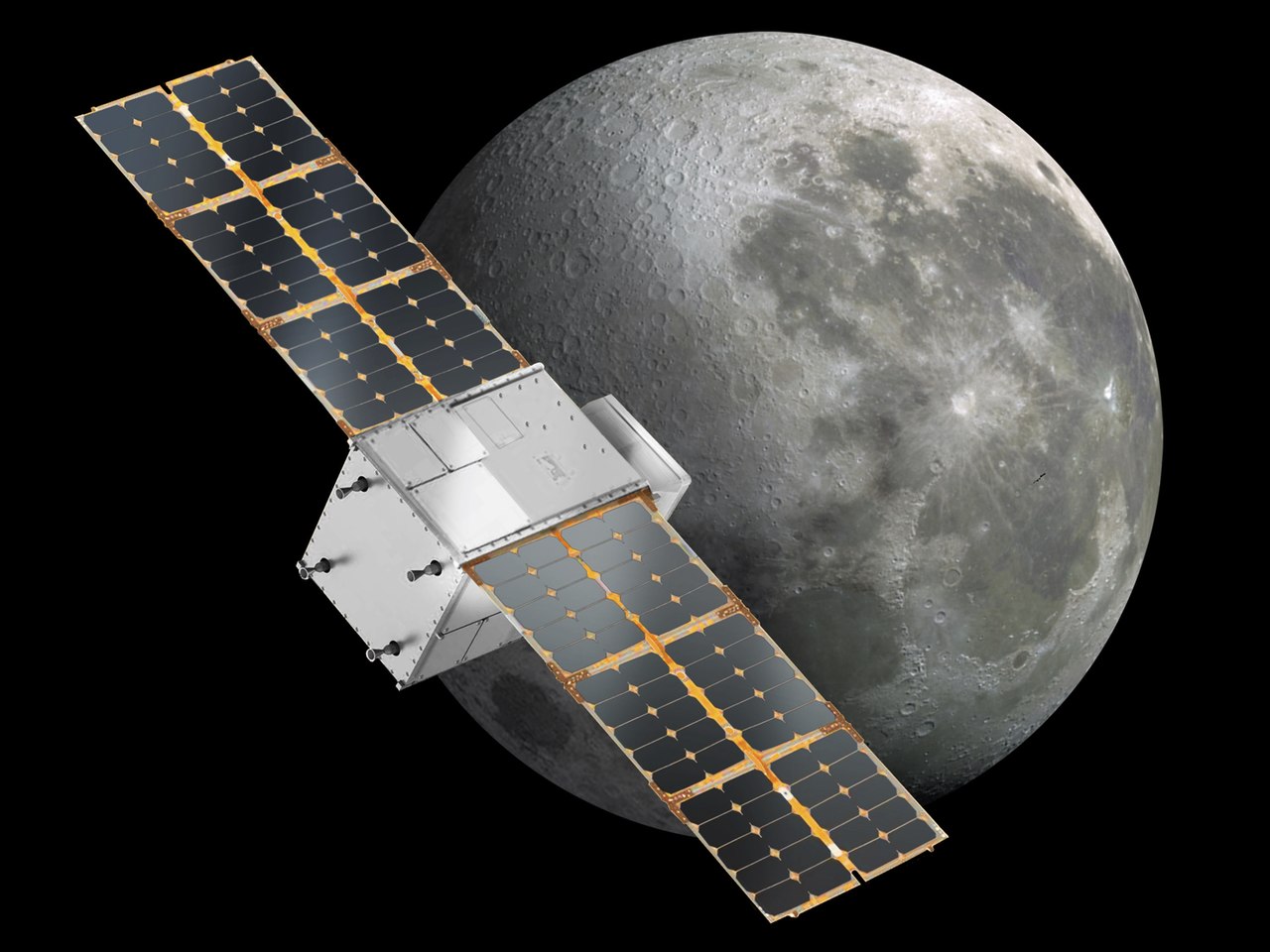
Enlarge/ A graphic representation of the Cislunar Autonomous Positioning System Technology Operations and Navigation Experiment in orbit near the Moon. (credit: NASA)
NASA and Rocket Lab are gearing up to fly a novel mission to lunar orbit that in many ways serves as the vanguard of what is to come as the space agency and US companies ramp up exploration and development of the Moon.
The space agency is financially supporting the privately built satellite, named CAPSTONE, with a $13.7 million grant. It is scheduled to launch on an Electron rocket as early as Saturday from New Zealand. Developed by a Colorado-based company named Advanced Space, the spacecraft itself is modestly sized, just a 12U cubesat with a mass of around 25 kg. It could fit comfortably inside a mini-refrigerator.
The mission's scientific aims are also modest—primarily, the demonstration of a new system of autonomous navigation around and near the Moon. This Cislunar Autonomous Positioning System, or CAPS, is important because there is a lack of fixed tracking assets near the Moon, especially as the cislunar environment becomes more crowded during the coming decade.
Keep it Clean. Please avoid obscene, vulgar, lewd,
racist or sexually-oriented language. PLEASE TURN OFF YOUR CAPS LOCK. Don't Threaten. Threats of harming another
person will not be tolerated. Be Truthful. Don't knowingly lie about anyone
or anything. Be Nice. No racism, sexism or any sort of -ism
that is degrading to another person. Be Proactive. Use the 'Report' link on
each comment to let us know of abusive posts. Share with Us. We'd love to hear eyewitness
accounts, the history behind an article.


(0) comments
Welcome to the discussion.
Log In
Keep it Clean. Please avoid obscene, vulgar, lewd, racist or sexually-oriented language.
PLEASE TURN OFF YOUR CAPS LOCK.
Don't Threaten. Threats of harming another person will not be tolerated.
Be Truthful. Don't knowingly lie about anyone or anything.
Be Nice. No racism, sexism or any sort of -ism that is degrading to another person.
Be Proactive. Use the 'Report' link on each comment to let us know of abusive posts.
Share with Us. We'd love to hear eyewitness accounts, the history behind an article.