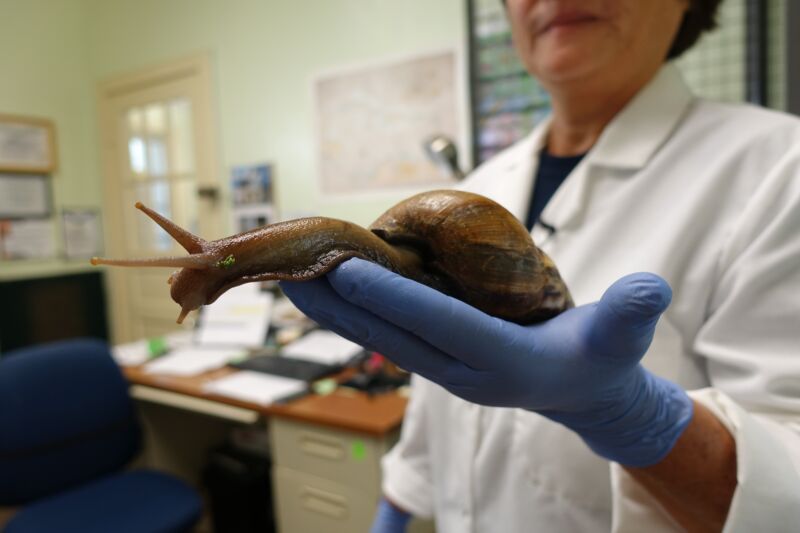
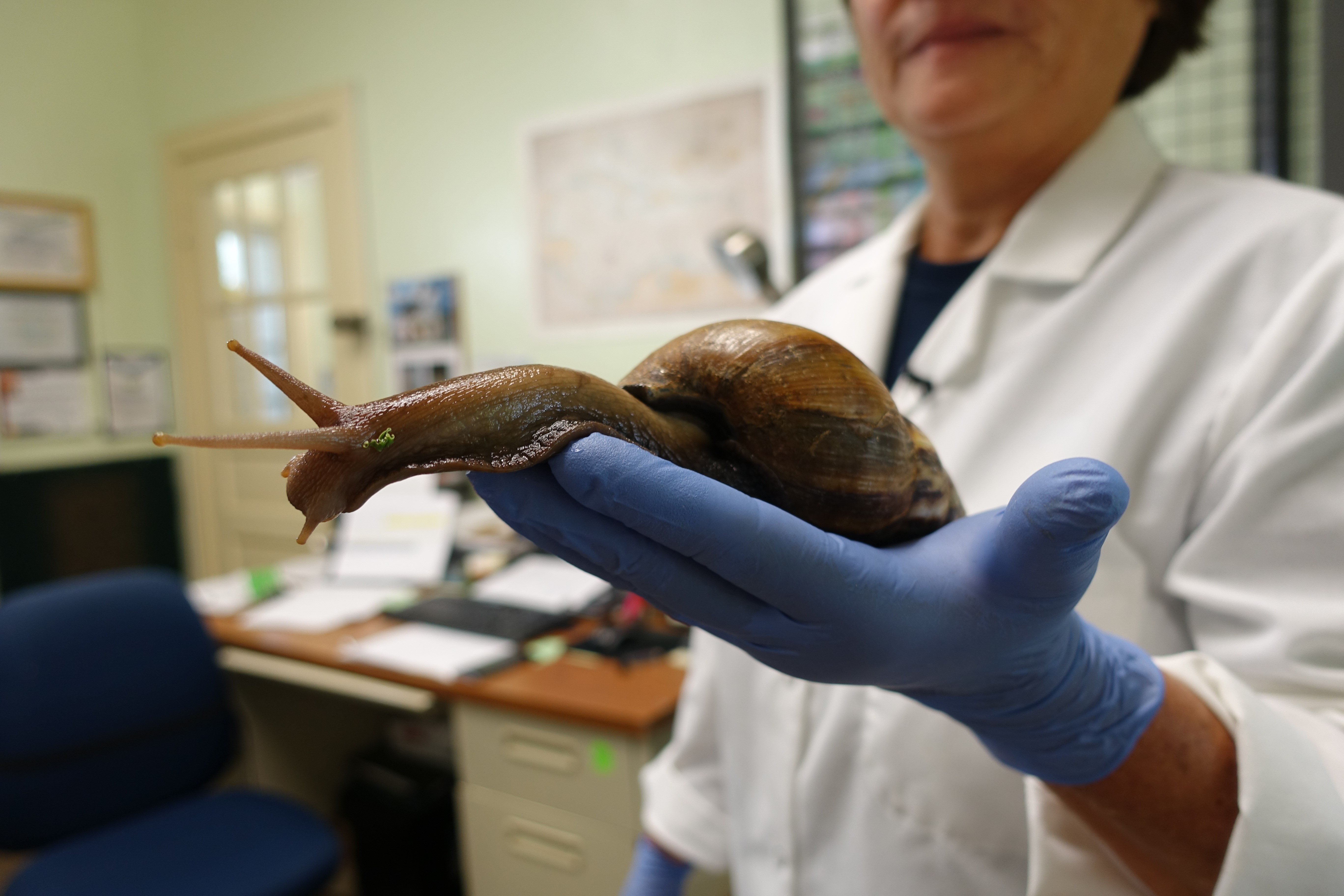
Enlarge/ Mary Yong Cong, a Florida Department of Agriculture scientist, holds a giant African snail in her Miami lab on July 17, 2015. (credit: Getty | Kerry Sheridan)
Officials in Florida are again battling a highly invasive, extraordinarily destructive giant snail species that also happens to be capable of spreading parasitic worms that invade human brains.
The giant African land snail (GALS)—aka Lissachatina fulica—can grow up to 20 centimeters (8 inches) long and is considered "one of the most invasive pests on the planet," according to the Florida Department of Agriculture and Consumer Services. It ravenously feasts on over 500 plant species—including many valuable fruits, vegetables, and ornamentals—while prolifically spawning, pushing out several thousand eggs in its multiyear life span.
In late June, Florida state officials confirmed the presence of GALS on a property in Pasco County, on the west-central coast of the state, just north of Tampa. They have since set up a quarantine zone around the property and began snail-killing pesticide treatments last week.
Keep it Clean. Please avoid obscene, vulgar, lewd,
racist or sexually-oriented language. PLEASE TURN OFF YOUR CAPS LOCK. Don't Threaten. Threats of harming another
person will not be tolerated. Be Truthful. Don't knowingly lie about anyone
or anything. Be Nice. No racism, sexism or any sort of -ism
that is degrading to another person. Be Proactive. Use the 'Report' link on
each comment to let us know of abusive posts. Share with Us. We'd love to hear eyewitness
accounts, the history behind an article.


(0) comments
Welcome to the discussion.
Log In
Keep it Clean. Please avoid obscene, vulgar, lewd, racist or sexually-oriented language.
PLEASE TURN OFF YOUR CAPS LOCK.
Don't Threaten. Threats of harming another person will not be tolerated.
Be Truthful. Don't knowingly lie about anyone or anything.
Be Nice. No racism, sexism or any sort of -ism that is degrading to another person.
Be Proactive. Use the 'Report' link on each comment to let us know of abusive posts.
Share with Us. We'd love to hear eyewitness accounts, the history behind an article.