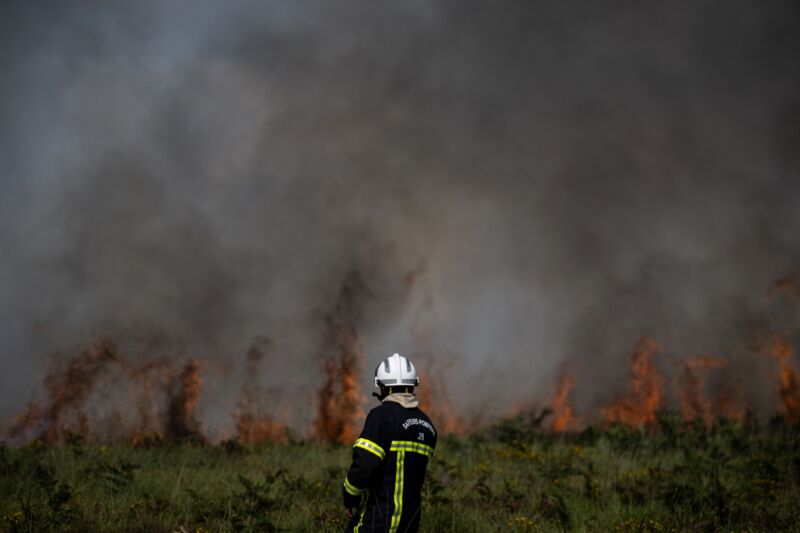
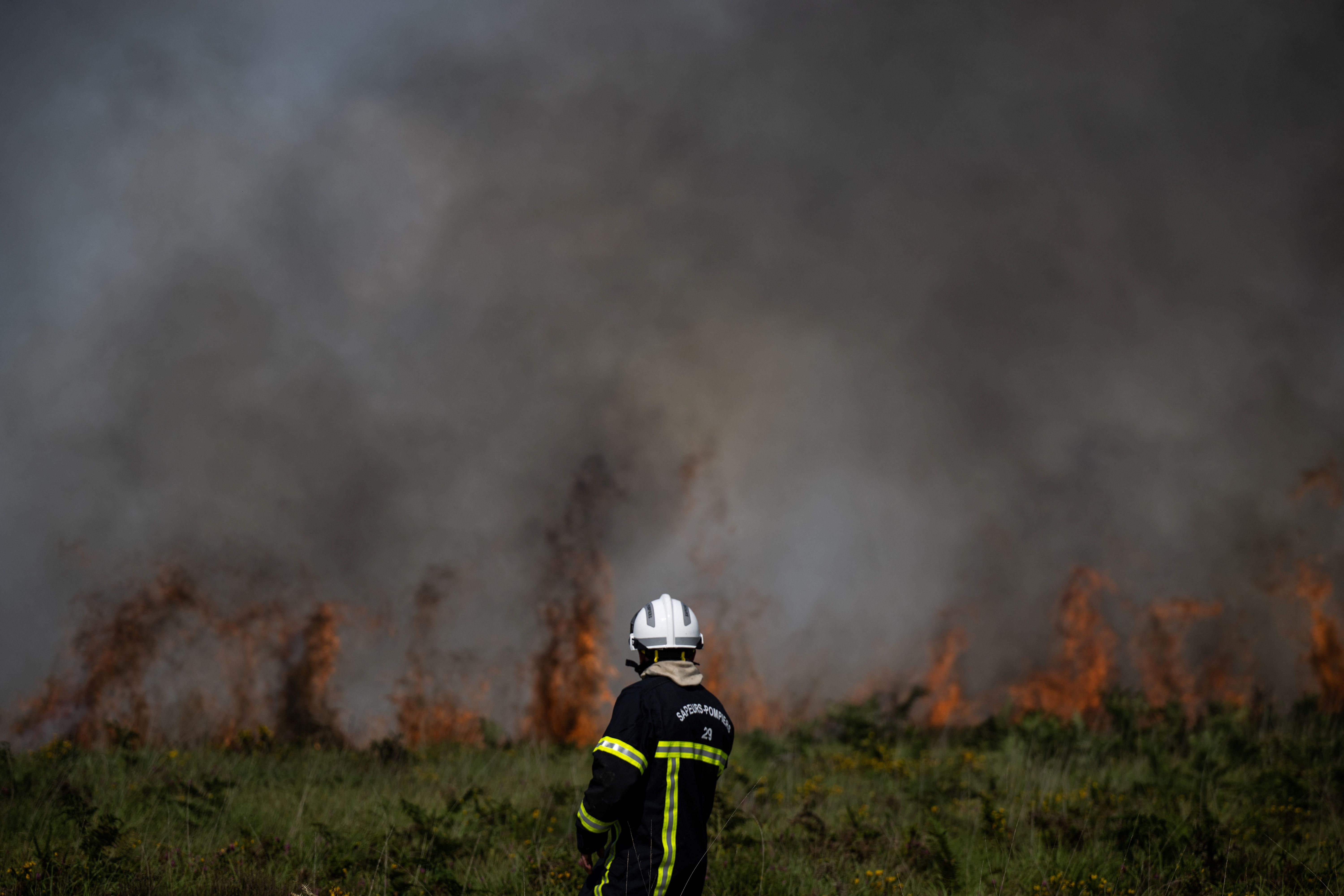
Enlarge/ A firefighter stands by flames as a wildfire rages in the Monts d'Arree, near Brasparts, Brittany, on July 19, 2022. A heatwave fueling ferocious wildfires in Europe pushed temperatures in Britain over 40° Celsius (104° Fahrenheit) for the first time after regional heat records tumbled in France. (credit: Loic Venance/Getty)
Europe is on fire: For days, temperatures have skyrocketed above 100° Fahrenheit (38° Celsius), shattering records and triggering huge wildfires that have forced tens of thousands from their homes. From Portugal to Spain to Greece, the flames have spread like a contagion. In the countryside surrounding Bordeaux, France, 75 square miles have charred in the past week. Blazes are even breaking out across London, a city not exactly known for fire weather.
Wildfires are, of course, a perfectly natural phenomenon and have periodically reset ecosystems for new growth throughout history. But in modern times, due to humanity's meddling with the climate and the landscape, these fires have ballooned into unnatural beasts that instead obliterate ecosystems. Fire historian Stephen Pyne has termed this the Pyrocene, an age of flames.
Keep it Clean. Please avoid obscene, vulgar, lewd,
racist or sexually-oriented language. PLEASE TURN OFF YOUR CAPS LOCK. Don't Threaten. Threats of harming another
person will not be tolerated. Be Truthful. Don't knowingly lie about anyone
or anything. Be Nice. No racism, sexism or any sort of -ism
that is degrading to another person. Be Proactive. Use the 'Report' link on
each comment to let us know of abusive posts. Share with Us. We'd love to hear eyewitness
accounts, the history behind an article.


(0) comments
Welcome to the discussion.
Log In
Keep it Clean. Please avoid obscene, vulgar, lewd, racist or sexually-oriented language.
PLEASE TURN OFF YOUR CAPS LOCK.
Don't Threaten. Threats of harming another person will not be tolerated.
Be Truthful. Don't knowingly lie about anyone or anything.
Be Nice. No racism, sexism or any sort of -ism that is degrading to another person.
Be Proactive. Use the 'Report' link on each comment to let us know of abusive posts.
Share with Us. We'd love to hear eyewitness accounts, the history behind an article.