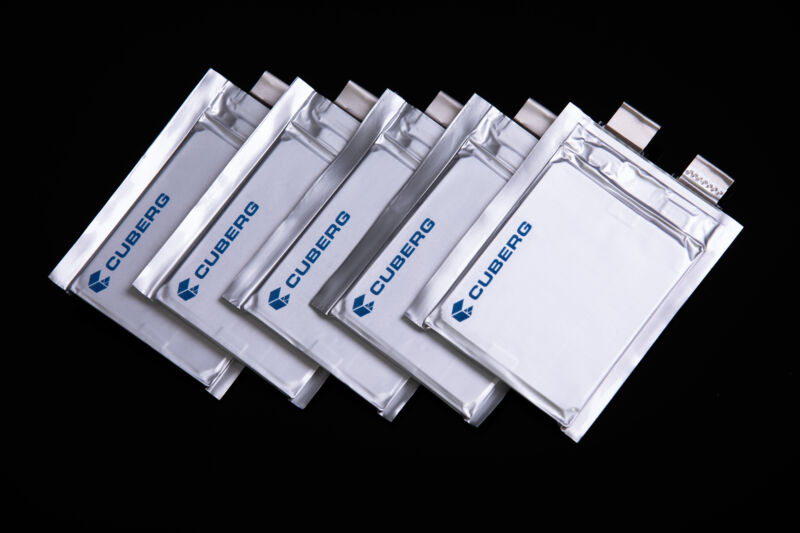
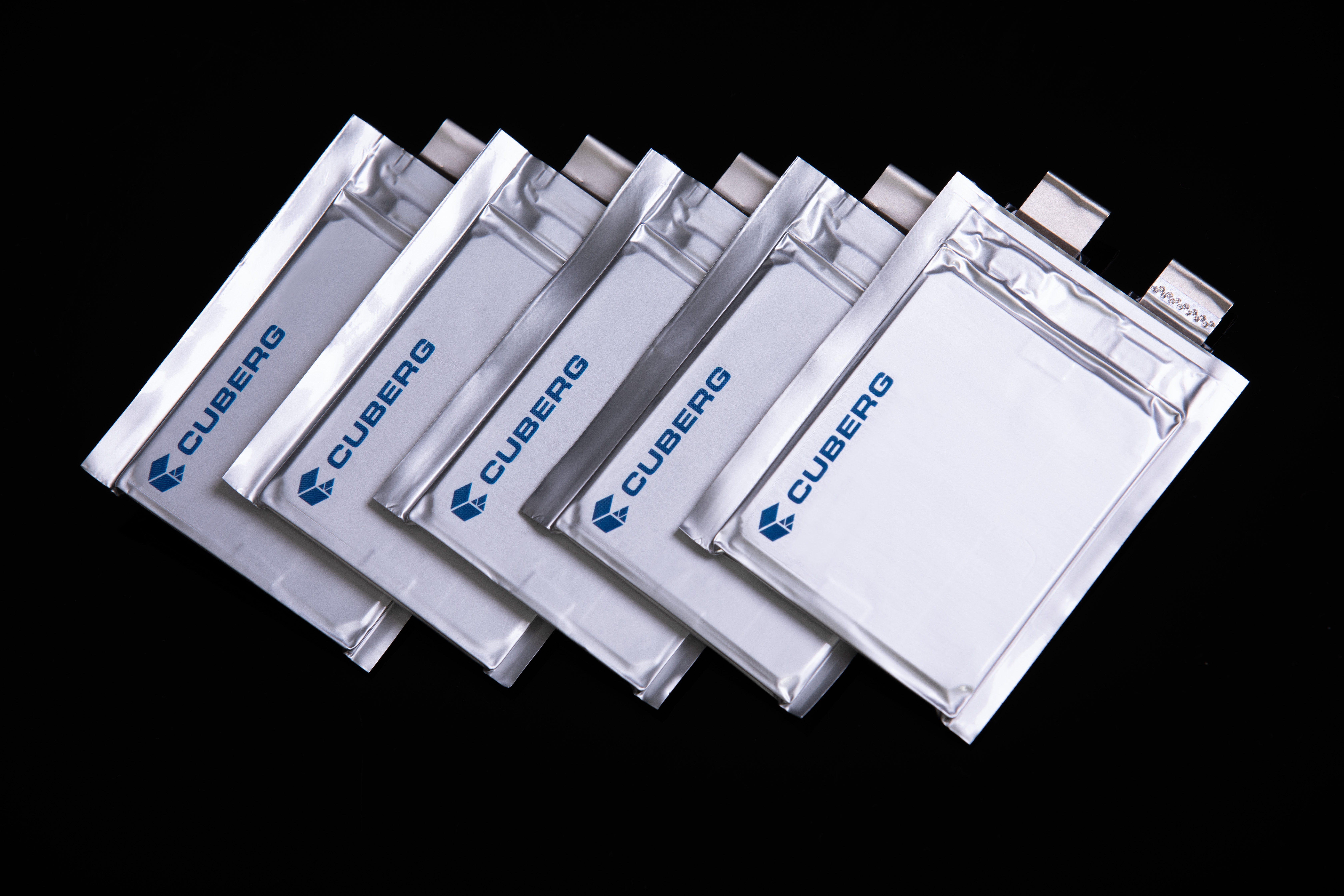
Enlarge/ Pouch cells of the sort tested for endurance. (credit: Cuberg)
While lithium-ion batteries have experienced steady improvements, a lot of research has gone into new chemistries that provide a much larger leap in performance. Some of that work has focused on materials like silicon or sulfur that can potentially store far more lithium than existing electrode materials. But other options get rid of electrode materials entirely. These include lithium-air and lithium-metal batteries.
All of these have faced issues with stability, with batteries based on the technology having a short life span compared to existing lithium-ion batteries (though batteries with some silicon are already in use). But on Thursday, a company is announcing that a lithium-metal battery it has in development has reached a stability that's competitive with existing lithium-ion batteries, retaining 80 percent of its initial capacity out to nearly 700 charge/discharge cycles—and that this has been validated by an outside testing lab.
To learn more about this advance and where lithium metal might get used, we talked with Richard Wang, founder of Cuberg, a subsidiary of battery giant Northvolt.
Keep it Clean. Please avoid obscene, vulgar, lewd,
racist or sexually-oriented language. PLEASE TURN OFF YOUR CAPS LOCK. Don't Threaten. Threats of harming another
person will not be tolerated. Be Truthful. Don't knowingly lie about anyone
or anything. Be Nice. No racism, sexism or any sort of -ism
that is degrading to another person. Be Proactive. Use the 'Report' link on
each comment to let us know of abusive posts. Share with Us. We'd love to hear eyewitness
accounts, the history behind an article.


(0) comments
Welcome to the discussion.
Log In
Keep it Clean. Please avoid obscene, vulgar, lewd, racist or sexually-oriented language.
PLEASE TURN OFF YOUR CAPS LOCK.
Don't Threaten. Threats of harming another person will not be tolerated.
Be Truthful. Don't knowingly lie about anyone or anything.
Be Nice. No racism, sexism or any sort of -ism that is degrading to another person.
Be Proactive. Use the 'Report' link on each comment to let us know of abusive posts.
Share with Us. We'd love to hear eyewitness accounts, the history behind an article.