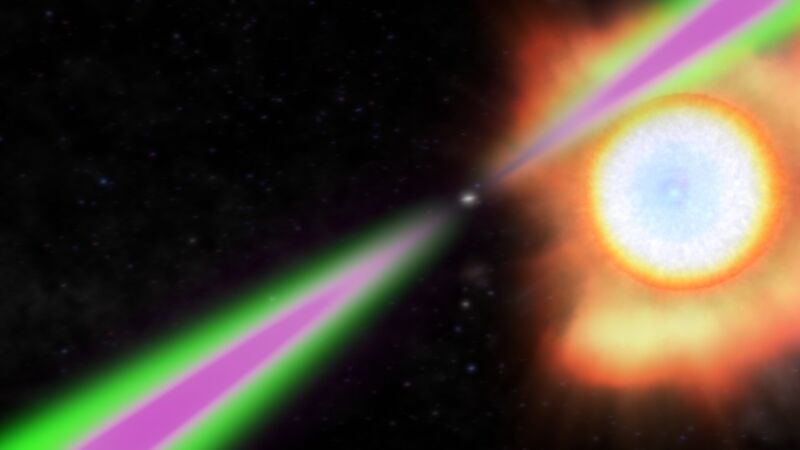
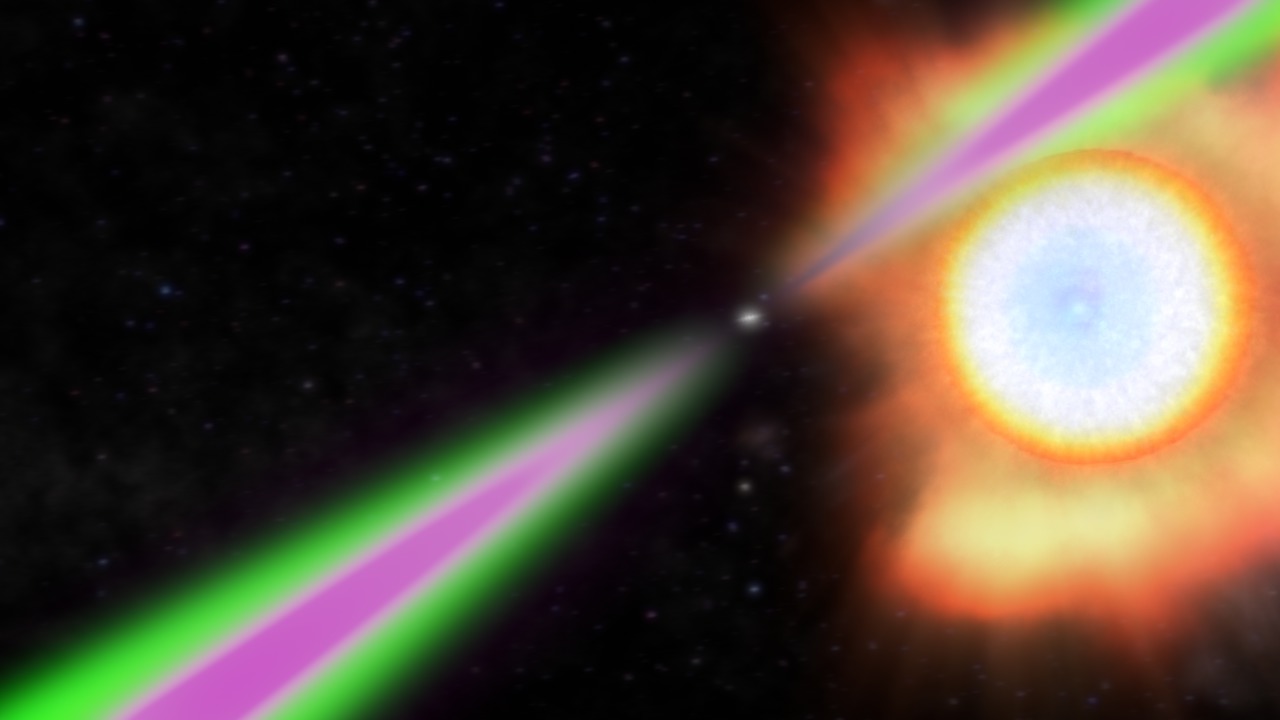
Enlarge/ An artist's impression of a neutron star getting ready to blast its neighbor with radiation. (credit: NASA)
Our Sun is on its own in this galaxy, without a nearby companion orbiting with it. But binary star systems are pretty common, and our nearest neighbor appears to be a three-star system. Given how many different types of stars there are, many multistar systems have a strange membership mix, with giant, unstable stars orbiting next to relatively mundane ones.
In Wednesday's issue of Nature, researchers report on a rarity: a "black widow" neutron star that's close enough to its companion to be blasting it with radiation. Should the process continue, it will ultimately lead to the star's evaporation and death. And, just for good measure, the pair also has a distant companion that's an old and rare dwarf star.
Searching for oddities
The work started in the archives of the Zwicky Transient Facility. The ZTF is designed to scan the entire sky in the Northern Hemisphere any two days and uses software to pick out anything that changes. Often, this would mean something blew up: A star suddenly brightens (in some cases becoming visible from Earth for the first time) because it has exploded as a supernova.
Keep it Clean. Please avoid obscene, vulgar, lewd,
racist or sexually-oriented language. PLEASE TURN OFF YOUR CAPS LOCK. Don't Threaten. Threats of harming another
person will not be tolerated. Be Truthful. Don't knowingly lie about anyone
or anything. Be Nice. No racism, sexism or any sort of -ism
that is degrading to another person. Be Proactive. Use the 'Report' link on
each comment to let us know of abusive posts. Share with Us. We'd love to hear eyewitness
accounts, the history behind an article.


(0) comments
Welcome to the discussion.
Log In
Keep it Clean. Please avoid obscene, vulgar, lewd, racist or sexually-oriented language.
PLEASE TURN OFF YOUR CAPS LOCK.
Don't Threaten. Threats of harming another person will not be tolerated.
Be Truthful. Don't knowingly lie about anyone or anything.
Be Nice. No racism, sexism or any sort of -ism that is degrading to another person.
Be Proactive. Use the 'Report' link on each comment to let us know of abusive posts.
Share with Us. We'd love to hear eyewitness accounts, the history behind an article.