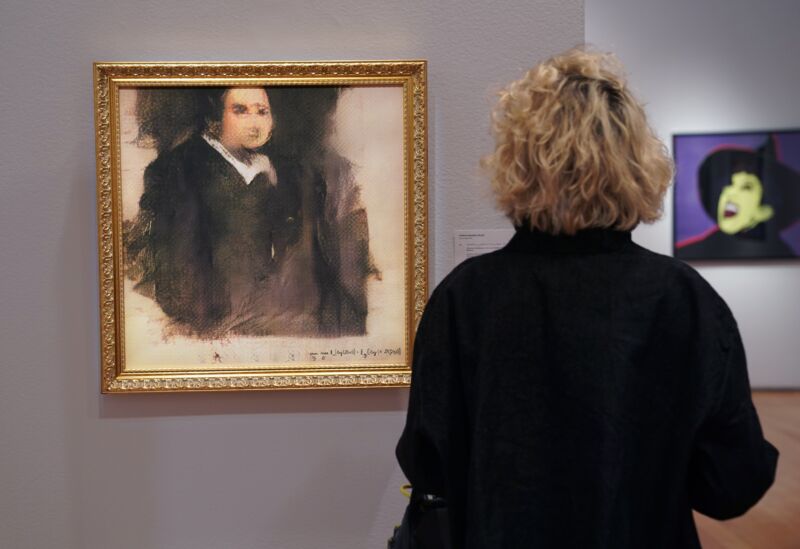
Enlarge/ A woman looks at a work of art created by an algorithm by French collective named OBVIOUS, which produces art using artificial intelligence, titled Portrait of Edmond de Belamy at Christie's in New York on October 22, 2018. The piece sold for $432,500. (credit: Timothy A. Clary/Getty)
In just a few years, the number of artworks produced by self-described AI artists has dramatically increased. Some of these works have been sold by large auction houses for dizzying prices and have found their way into prestigious curated collections. Initially spearheaded by a few technologically knowledgeable artists who adopted computer programming as part of their creative process, AI art has recently been embraced by the masses, as image generation technology has become both more effective and easier to use without coding skills.
The AI art movement rides on the coattails of technical progress in computer vision, a research area dedicated to designing algorithms that can process meaningful visual information. A subclass of computer vision algorithms, called generative models, occupies center stage in this story. Generative models are artificial neural networks that can be “trained” on large datasets containing millions of images and learn to encode their statistically salient features. After training, they can produce completely new images that are not contained in the original dataset, often guided by text prompts that explicitly describe the desired results. Until recently, images produced through this approach remained somewhat lacking in coherence or detail, although they possessed an undeniable surrealist charm that captured the attention of many serious artists. However, earlier this year the tech company Open AI unveiled a new model—nicknamed DALL·E 2—that can generate remarkably consistent and relevant images from virtually any text prompt. DALL·E 2 can even produce images in specific styles and imitate famous artists rather convincingly, as long as the desired effect is adequately specified in the prompt. A similar tool has been released for free to the public under the name Craiyon (formerly “DALL·E mini”).
Keep it Clean. Please avoid obscene, vulgar, lewd,
racist or sexually-oriented language. PLEASE TURN OFF YOUR CAPS LOCK. Don't Threaten. Threats of harming another
person will not be tolerated. Be Truthful. Don't knowingly lie about anyone
or anything. Be Nice. No racism, sexism or any sort of -ism
that is degrading to another person. Be Proactive. Use the 'Report' link on
each comment to let us know of abusive posts. Share with Us. We'd love to hear eyewitness
accounts, the history behind an article.


(0) comments
Welcome to the discussion.
Log In
Keep it Clean. Please avoid obscene, vulgar, lewd, racist or sexually-oriented language.
PLEASE TURN OFF YOUR CAPS LOCK.
Don't Threaten. Threats of harming another person will not be tolerated.
Be Truthful. Don't knowingly lie about anyone or anything.
Be Nice. No racism, sexism or any sort of -ism that is degrading to another person.
Be Proactive. Use the 'Report' link on each comment to let us know of abusive posts.
Share with Us. We'd love to hear eyewitness accounts, the history behind an article.